

Computational complexity theorists show gravity must be quantised
Physicists have long sought a Theory of Everything using geometry and symmetry. Now computational boundaries--what a physical machine can and cannot calculate--may be a better guide

Consider, for a moment, the humble Sudoku puzzle. Filling in a blank grid from scratch is hard and as the grid increases in size, the number of possible arrangements grows explosively. Yet checking whether a completed grid is valid takes only moments.
This asymmetry between finding a solution and verifying one sits at the heart of one of the deepest unsolved problems in mathematics and computer science: the P versus NP question. It asks, in essence, whether every problem whose solution can be quickly checked can also be quickly solved. Most experts believe the answer is no (although there is no proof, despite the $1 million Millennium prize for the first person to find one).
You could be forgiven for thinking this is a question purely of mathematics and computer science but physicists have grown to think that it has profound connections to the nature of the universe, because every computer is a physical machine. Indeed, many physicists and mathematicians believe that there is growing evidence that this mathematical reality is somehow deeper than the laws of physics; that underneath it all, the properties of information and the way we process it form a deeper bedrock for reality.
Fundamental reality
That’s the context in which we come to one of the most profound questions in physics: whether gravity, like everything else at a fundamental level, is quantum mechanical. Physicists suspect it is but lack the evidence to prove it. Indeed, they often fall back on a simpler picture in which gravity is classical but can couple to quantum matter. This semiclassical framework produces some useful results but has long been suspected of harbouring unusual properties.
Enter Matthew Fox of the University of Colorado in Boulder, Chaitanya Karamchedu of the University of Maryland in College Park and Sotirios Mygdalas of the Perimeter Institute for Theoretical Physics in Waterloo, Canada. Together, these theoreticians have explored the computational properties of the theory of semiclassical gravity for the first time. Their conclusion is that this view of the universe allows computation so wild and powerful, that the theory cannot be correct.
This points them to a profound conclusion. If the theory generates impossible results, the assumption behind it -- that gravity is classical -- cannot be correct. And if gravity cannot be classical, it must therefore be quantum.
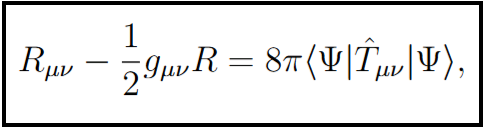
This is how they reach this conclusion. Fox and co began be thinking about what happens when quantum matter is influenced by a classical gravitational field via the semiclassical Einstein field equations. In this framework, a massive quantum particle does not simply spread out as an ordinary quantum wavefunction would, it also gravitationally attracts itself. This self-attraction is captured by the Schrödinger–Newton (SN) equation, which modifies ordinary quantum dynamics by introducing a gravitational self-interaction potential. Crucially, this modification makes the dynamics non-linear — and non-linearity, it turns out, is computationally explosive.
The connection between non-linear quantum dynamics and computational hardness was established in work by Daniel Abrams and Seth Lloyd in 1998 and later generalised by Ning Bao, Adam Bouland and Stephen Jordan. Their central insight is that any non-linear quantum evolution necessarily “stretches” the state space in a way that standard, linear quantum mechanics cannot.
So any two quantum states that are exponentially close together can be driven to a macroscopically distinguishable distance apart in only polynomially-many steps. By contrast, in ordinary quantum mechanics, which is completely linear, this would take exponentially-many steps.
This amplification is precisely what computer scientists need to solve NP-complete problems efficiently. That’s because deciding such problems can be reduced to distinguishing between two quantum states that differ by an exponentially small amount.
The implications extend well beyond the Schrödinger–Newton equation specifically. Because the mathematical theorem underpinning the argument applies to any non-linear quantum dynamics, the researchers argue that essentially any semiclassical theory in which quantum matter couples non-linearly to a classical gravitational field would produce the same result.
This would violate a foundational principle of theoretical computer science known as the Physical Extended Church–Turing Thesis (PECTT), which holds that no physical process can efficiently solve NP-complete problems.
“Any consistent, semiclassical, and non-linear matter-gravity coupling will entail an efficient algorithm to solve NP-complete problems and thus violate the PECTT,” says Fox and co. The only clean way out is to quantise gravity, which restores linearity to the dynamics and removes the self-interaction potential altogether. “Quantizing gravity restores linearity and thus avoids our argument altogether,” they conclude.
The work does not rule out every alternative. One could, in principle, abandon the PECTT itself, or seek a semiclassical theory whose density-matrix evolution happens to be linear even if the underlying wavefunction dynamics are not — a path explored in Oppenheim’s post-quantum theory.
But each such escape carries a heavy conceptual price. The cleaner and more natural resolution, Fox and colleagues argue, is simply that gravity is quantum. The result therefore constitutes a powerful new theoretical argument for the quantisation of gravity. It joins a long tradition of indirect theoretical arguments for quantum gravity with an unusual twist. It draws its force not from thought experiments about information or thermodynamics, but from the computational structure of the physical world.
Ref: arxiv.org/abs/2606.14806: Semiclassical Gravity Efficiently Solves NP-Complete Problems
INSIGHT
This paper sits at a remarkable intersection of gravitational physics and computational complexity theory, and its central finding carries deep implications for how we understand the fundamental structure of physical reality.
The authors demonstrate that if gravity remains classical — governed by the semiclassical Einstein field equations — then the resulting non-linear dynamics would, in principle, allow NP-complete problems to be solved in polynomial time. This would shatter the Physical Extended Church-Turing Thesis (PECTT), a foundational principle asserting that no physical process can efficiently solve such problems. The significance is profound: computational limits are not merely mathematical abstractions but appear to be encoded into the fabric of physics itself.
What makes this finding so striking is its inversion of the usual direction of inquiry. Rather than asking what physics can tell us about computation, the authors ask what computational constraints can tell us about physics — and the answer is striking. The apparent universality of the PECTT acts as a kind of consistency test that candidate physical theories must pass. Semiclassical gravity fails this test.
The broader implication is that computational complexity theory may function as a genuine selection principle for fundamental theories, sitting alongside established tools like symmetry and renormalisability. But is this contradiction between a physical theory and computational theory sufficient grounds for its rejection?
If it is — and Fox and co clearly lean that way — computability and physical law are not merely analogous but constrained at some deeper level that we have not yet grasped. And therein lies an inherently more exciting and profound problem.