

Quantum internet experiment tested on commercial optical fibres
The first demonstration of quantum entanglement experiments alongside commercial optical communications paves the way for the quantum internet to be built on existing networks, says researchers

Planet Earth is criss-crossed by a global communications network made almost entirely of glass fibre designed to carry photons. Powerful protocols pack data into these fibres at mind boggling rates—modern optical fibres carry hundreds of terabits per second, while coping easily with the noise that fills these strands.
While conventional optical communication thrives in these conditions, it is a problem for quantum communication. Certain types of noise can generate photons that look just like the ones carrying quantum information and so overwhelm them. That’s why most quantum optics experiments take place in dark fibres that are physically separate from the powerful turmoil of commercial communications.
But if quantum communication is ever to become mainstream, quantum engineers will either need to build their own parallel network of optical fibre—a hugely expensive option—or find a way to operate alongside commercial signals.
Quantum signals
Enter Gina Talcott at the Northwestern University in Evanston, Illinois, and colleagues who have successfully sent quantum signals through a fibre packed with commercial signals for the first time. “To the best of our knowledge, this is the first implementation of entanglement-based quantum communications between two remote nodes coexisting with independent classical communications traffic,” they say.
Their work suggests that a quantum internet, and all the benefits it offers, could run on the same global infrastructure that the conventional internet and almost all other communications rely on.
The essential problem for quantum engineers is that life inside an optical fibre is surprisingly complex. Standard telecoms fibres carry multiple signals by dividing them into different wavelengths. These communications bands all sit within the infrared part of the spectrum and range from the “original” O-band operating at 1260-1360nm, via the “conventional” C-band, optical communication’s workhorse at 1530-1565nm, to the “ultra-long” U-band operating between 1625-1675nm.
But telecoms engineers also pack the C-band with noise from optical amplifiers called amplified spontaneous emission, that makes the optical environment even more chaotic. This provides a buffer against optical surges in case one signal drops out. When that happens, optical amplifiers can dump all their power into the remaining signals. The noise evens this out.
There is another type of noise that is even more insidious. All these photons inevitably interact with molecules within the fibre leading to an effect called spontaneous Raman scattering. This lengthens the wavelength of the photons, which then leak into other bands. These are the photons that interfere with quantum communications.
So an optical fibre contains a maelstrom of powerful optical signals, deliberately engineered noise as well as unwanted noise that leaks from one band to another. Who said it was easy being a photon.
The key to Talcott and co’s breakthrough is their clever allocation of the existing optical communication bands. Most commercial signals use the C-band between 1530nm and 1565 nm.
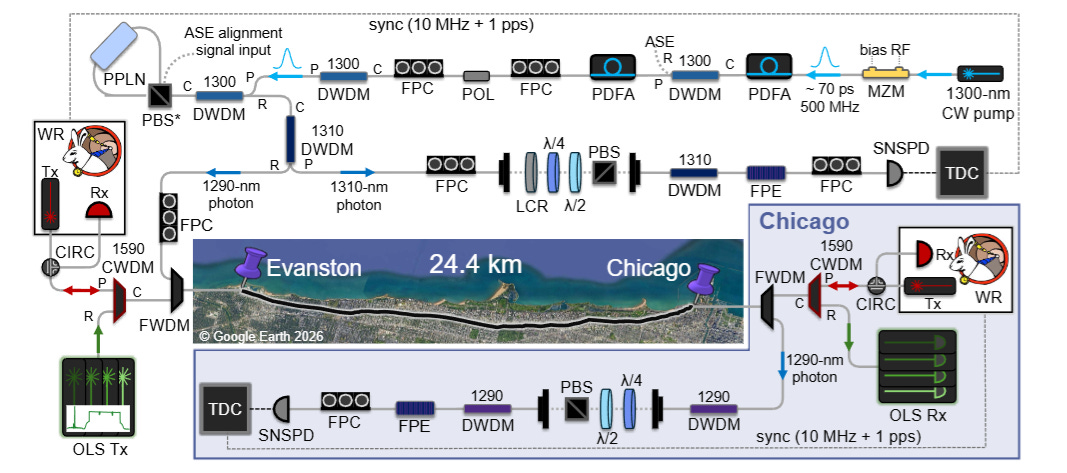
In their experiments, Talcott and co pushed two channels at 800 Gigabits per second through the C-band and filled the rest of the capacity with noise from amplified spontaneous emission to simulate a fibre at full capacity, a standard practice in telecoms.
And because spontaneous Raman scattering tends to produce photons with longer wavelengths, these leak into other bands making them unusable for quantum comms.
Talcott and co’s solution is simple. They confine their quantum photons to the O-band, which has a shorter wavelength and so is less affected by spontaneous Raman scattering.
A small portion of these scattered photons have shorter wavelengths that leak into the O-band but Talcott and co show it does not significantly influence the fidelity of their quantum signals.
Bandwidth blues
The O-band has another potential disadvantage, which is that it has a higher propagation loss—light just doesn’t travel as efficiently at these wavelengths. That means signals fade more quickly as they travel and so need repeating more regularly, which is why this band is less popular for conventional signals.
But Talcott and co’s experiments reveal that this disadvantages is not a showstopper for quantum communication over urban distances. They carried out their experiments over 24.4 kilometres of installed fibre running from the Northwestern University campus in Evanston to a communications exchange in Chicago.
And the measurements show that the quantum properties of their photons are well preserved. “These results demonstrate that quantum-classical networks could be implemented with little to no degradation in the quality of quantum entanglement distribution,” they say.
Ref: arxiv.org/abs/2602.00253 : Synchronized distribution of quantum entanglement coexisting with high-rate, broadband classical optical communications over a real-world fiber link
INSIGHT
This result bridges the gap between laboratory physics and industrial reality to offer significant real world applications. The telecoms O-band has long been underused in long-haul networks. Now Talcott and co have shown it is ideal for quantum comms because it offers noise levels that are orders of magnitude less than standard C-band data traffic.
The team also demonstrate that this works on real-world metropolitan fibre connecting 24/7 telecoms facilities.
But the big reveal is that this makes quantum communications dramatically scalable. Until now, the expectation was that quantum communications would need its own fibre free from the noise of commercial comms and that this would be hugely expensive to install. By eliminating the need for expensive, dedicated “dark fibre,” this work makes a global quantum internet economically viable by using existing metropolitan infrastructure.
That’s no mean feat. If a reminder is needed, the quantum internet is potentially unhackable, offering provably secure communication for government, finance and others. It will allow distributed quantum computing by connecting remote processors to create a massive unified computational resource. And it will catalyse the emergence of quantum-enhanced sensing for medical imaging, ultraprecise clock synchronisation and superior global positioning. All on a global scale.