


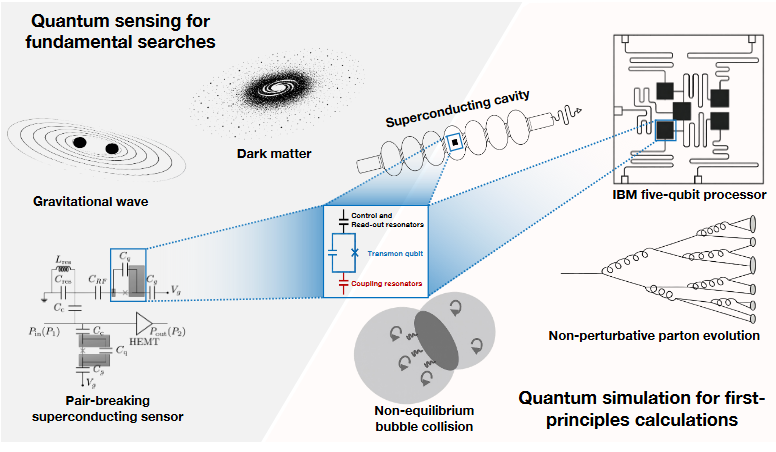
ONE of the key challenges for the emerging quantum computer industry is to isolate their machines from the noise of the outside universe. Cosmic rays, magnetic fields and electromagnetic waves all destroy the quantum coherence that these computers rely on. Isolation is an engineering imperative.
But by a strange symmetry, these same devices turn out to be hugely sensitive detectors. Which is why particle physicists are using the same machines in reverse, exposing them to the noisy universe to detect new physics in the form of dark matter, high-frequency gravitational waves and who knows what else.
That has created two multi-billion dollar enterprises facing many of the same engineering challenges with the same kit. An unusually generous gift from the physics gods.
Now Itay Bloch from the Lawrence Berkeley National Laboratory in California, and an international team, explore the nature of this gift in a wide-ranging review of the way quantum technologies are revolutionising particle physics. Along the way, they identify a fascinating but unsolved physics problem hiding within the quantum computing industry that threatens to significantly hinder progress for both groups.
First some background. Physicists have long known that decoherence occurs when noise leaks into a quantum environment. This noise destroys the fragile quantum states that physicists exploit to perform tasks such as running ever more powerful quantum algorithms.
When all known sources of noise have been carefully screened out, any further decoherence or excitation becomes a candidate for new physics. That’s the thinking behind various dark matter detectors that look for the signal from a collision with an unknown particle. This might excite a quantum state or destroy its coherence entirely.
The question then becomes what kind of particle is involved, how energetic it is and so on. This requires a level of calibration that physicists are still perfecting. But proof-of-principle demonstrations are already emerging.
The inversion of quantum computing technology comes from a specific type of detection using superconducting qubits. These are tiny electronic circuits in which pairs of electrons—Cooper pairs—move freely through the material without bumping into the lattice structure itself. In other words, the current flows with zero resistance.
In superconducting qubits, Cooper pairs to tunnel through a junction between two superconducting islands at a variety of energy levels. When excited at a specific microwave frequency, the qubit flips between the two lowest energy states, a 0 and a 1. That’s how quantum information is written into the device.
A collision with an unknown particle changes this by destroying Cooper pairs and creating a quasiparticle that itself tunnels across junction. This changes the parity of the superconducting island and the transition frequency in a way that is straightforward to detect. “In theory, … [a] qubit can sense a single Cooper pair breaking,” say Bloch and co.
That’s where the interests of particle physicists and quantum computer scientists diverge. For quantum computation, these events must be kept to a minimum because they destroy calculations. But for detectors, these events are the signal.
But both teams now face a problem that began to emerge about ten years ago. At that time, physicists were increasing the energy sensitivity of dark matter detectors. Several different groups noticed that this increased sensitivity was revealing a new source of background noise that had previously been hidden.
At first, everyone thought it was caused by impurities in their materials. But that began to seem unlikely since the various groups reported the same effect despite using different approaches.
The noise has some curious properties. It consists of a spectrum of tiny phonons bursts that occur in every material physicists have tested. It is non-ionising and so can’t be caused by radioactivity. Neither does it scale with detector volume in any simple way.
When a material is cooled to millikelvin temperatures, the noise decays over a period of weeks but reappears every time the detector is warmed up and cooled again. Nobody knows what causes it although one source has been pinned down: the mechanical stress in a material caused by the way it is clamped in its mount.
Known as the low energy excess, it has become the bane of these physicists’ lives. Quantum computing specialists have found the same thing. “Qubit experiments confirmed similar low energy excess rates,” say Bloch and co.
Perhaps that’s why they call it “infamous”. For dark matter scientists, it overwhelms the energy range where the lightest dark matter candidates might show up. For quantum computer scientists, it limits how long qubits can remain coherent. “Further studies are urgently needed to understand the microscopic origin of the bulk low energy excess events,” say Bloch and co.
Read the top stories from the Physics arXiv blog
1. Next generation AI attack vectors will be ideas, say Anthropic researchers
2. Computational complexity theorists show gravity must be quantised
3. Mathematicians say ant colony problem-solving is isomorphic to machine learning
And if one unknown source of noise weren’t bad enough, both groups have another to deal with—unwanted qubits that appear in the surfaces of superconducting materials. These materials should be perfectly crystalline but inevitably contain amorphous regions on their surfaces.
In these regions at millikelvin temperatures, rogue atoms can tunnel back and forth between almost equivalent positions, creating two-level systems analogous to qubits. And every time one flips, it shifts the local electrical environment creating noise.
That’s the thinking but nobody has yet nailed the details well enough to eliminate them. “Understanding the microscopic origin of two-level systems and reducing them is a critical path to the realization of logical qubits and large-scale quantum computing,” say Bloch and co, perhaps in the hope that research teams at Google and IBM are best placed (and funded) to solve this problem.
And therein lies the big asymmetry at the heart of this story. The companies chasing the dream of large-scale quantum computation are better funded and more aggressively motivated to solve these problems than particle physicists. What seems clear, however, is that both groups need each other, perhaps more than they had appreciated.
Ref: Particle Physics Driven by Quantum Technology – Quantum Simulations and Quantum Sensing : arxiv.org/abs/2609.20500
INSIGHT
The main insight from this paper is the unexpected symbiosis between two communities that seemingly want opposite things. Quantum computing firms spend fortunes eliminating the events that break Cooper pairs; dark matter experiments spend fortunes counting them. Yet because both build superconducting circuits on crystalline substrates and operate them at millikelvin temperatures, they have converged on the same two mysteries: the low energy excess and two-level systems. And here’s the rub. Neither seems able to reach its goal without solving them.
That suggests a parallel future. Materials scientists will need to develop cleaner materials in the expectation that this will solve the problem of two-level systems, or at least some of it. Solid state physicists will need to develop quantum metrology techniques to characterise whatever noise remains.
Those are tasks best suited to the research facilities at the world’s most elite institutions but will require budgets more commonly found at the world’s best-funded companies. Quantum companies would get longer coherence times while particle physicists would get industrial-scale investment in the hunt for new physics.
The benefits would be legion. Perhaps dual-use cryogenic facilities, shared materials databases and quantum processors doubling as dark matter detectors between computations. But only if the quantum gods are feeling generous.